Infrastructure Modernization in CEE: The Rail, Road, and Port Boom
The Via Carpatia and North-South Corridors
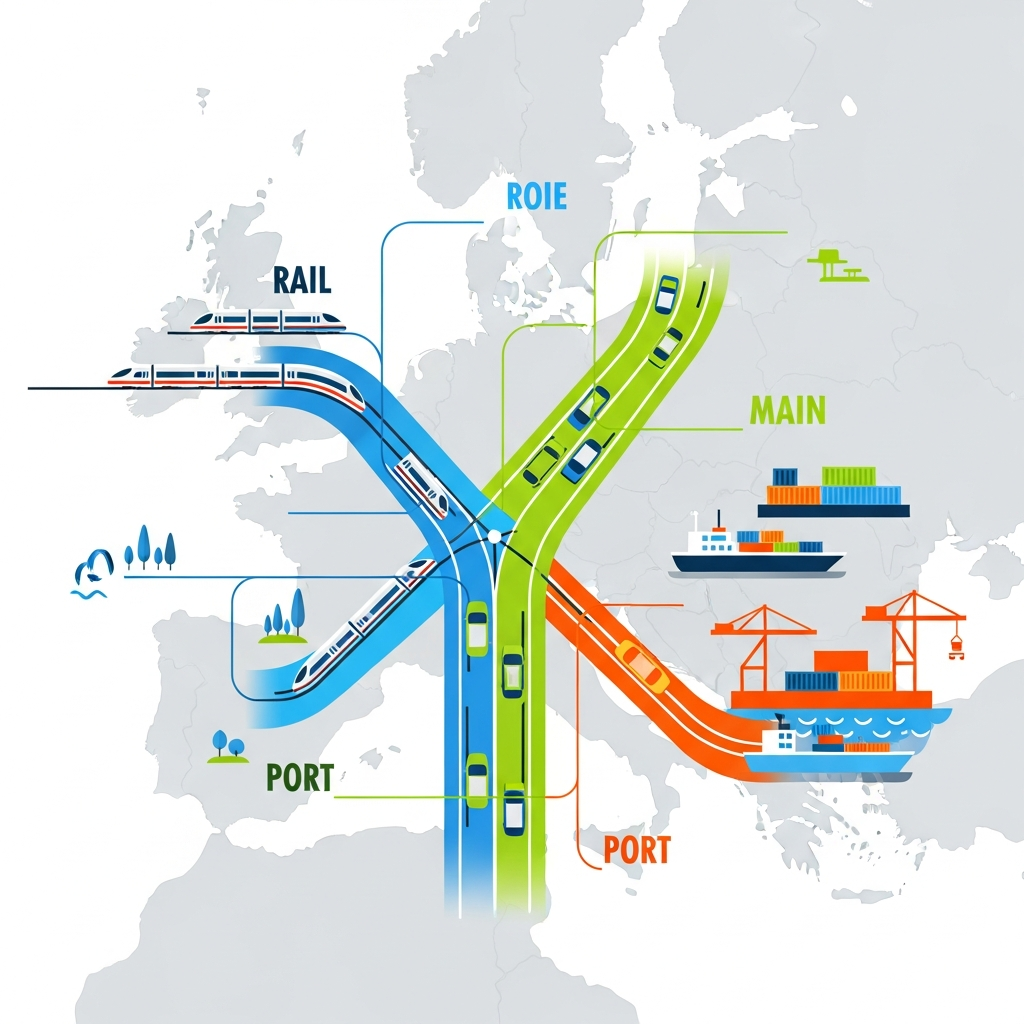
The Via Carpatia is a transnational highway network connecting the Baltic, Aegean, and Black Seas, with its Polish segment aggressively expanding in 2026 to shift European transit flows toward a north-south axis.
Poland’s road infrastructure is entering a phase of intense execution. The General Directorate for National Roads and Motorways (GDDKiA) commands a historic 20 billion PLN investment budget this year. You will see nearly 290 kilometers of new expressways open by the end of 2026. Eastern regions are securing the bulk of these upgrades.
The S19 expressway forms the crucial backbone of the Via Carpatia route. Several vital sections across the Podlasie, Lublin, and Podkarpackie voivodeships reach completion stages this summer. Heavy machinery is currently boring the massive dual-tube tunnel under Rzeszów. This specific engineering feat eliminates a notorious terrain bottleneck near the Slovak border.
In our practice tracking CEE markets, we consistently see logistics operators restructuring their regional supply chains. They are moving away from congested east-west transit routes to capitalize on these new north-south arteries. Shorter travel times translate directly into reduced operational costs. Smart transport firms are already securing commercial land near the upcoming S19 interchanges.
Geopolitics heavily influence this specific infrastructure priority. The ongoing war across Poland’s eastern border highlights the absolute necessity for rapid, secure north-south military mobility. The Via Carpatia integrates directly into NATO’s dual-use transport framework. Commercial trucks and military convoys will share these reinforced, high-capacity road surfaces.
Transnational connectivity defines the true value of this corridor. Lithuanian logistics hubs now integrate seamlessly with Polish industrial zones via the Suwałki Gap region. Trucks can bypass central Warsaw entirely when moving goods from the Baltics down to the Balkans. You bypass severe urban traffic congestion, saving hours on tight delivery schedules.
Regional economic zones are booming alongside the fresh asphalt. Warehousing giants are pouring capital into secondary Polish cities like Lublin and Rzeszów. These previously overlooked municipalities now offer prime real estate with direct European highway access. You should anticipate a massive spike in localized commercial real estate values throughout 2026 and 2027.
Expanding the Port of Gdansk’s Capacity
The Port of Gdansk is a central maritime hub for the Baltic region that recently surpassed 80 million tonnes in annual cargo volume and is actively expanding its deep-water terminals in 2026.
Liquid fuels and container traffic drive this unprecedented maritime expansion. Following the successful completion of the Baltic Hub’s T3 terminal, total container handling surged to a record 2.8 million TEU. Port authorities are aggressively pushing for more capacity. They signed a 114.6 million PLN contract in February 2026 to redevelop the Górniczy Basin.
This new investment precisely targets the Węglowe and Administracyjne Quays. Construction crews are increasing the technical depth to exactly 12 meters. Such upgrades allow the port to safely accommodate massive bulk vessels up to 100,000 DWT. The project also modernizes the vital rail hinterland to streamline immediate cargo offloading.
Data from recent corporate setups shows a massive shift toward Polish ports. Major global distributors are actively bypassing traditional western maritime gateways like Hamburg or Rotterdam. You can now route deep-sea cargo directly into the heart of Eastern Europe faster and cheaper. Gdansk has cemented its status as an indispensable regional logistics node.
Energy security drives a massive portion of the current port traffic. Naftoport operations reached staggering new heights, handling exactly 379 crude oil tankers over the past year. The facility is currently constructing its sixth liquid fuels handling berth. This specialized dock will service the largest class of oil tankers worldwide.
Poland is also actively advancing plans for a second floating LNG import terminal (FSRU) within the Gdansk waters. This unit anchors Europe’s continued commitment to independent energy infrastructure. You witness a structural shift away from eastern gas pipelines toward global liquefied natural gas markets. Gdansk serves as the primary distribution valve for the entire CEE region.
Offshore wind installation terminals represent another critical growth vector. Contractors are pouring concrete for specialized quays designed to handle massive turbine blades and tower sections. The Baltic Sea is rapidly becoming a premier renewable energy basin. The Port of Gdansk positions itself as the primary staging ground for these multi-billion euro wind farms.
Rail integration remains the final puzzle piece for maritime efficiency. The current modernization of the Górniczy Basin includes completely rebuilding rail tracks 301, 302, 303, and 344. Automated ro-ro ramps will soon facilitate rapid transfer of rolling cargo directly onto waiting trains. You simply cannot maintain peak port efficiency without a frictionless inland rail connection.
The Solidarity Transport Hub (CPK) Debate
The Central Transport Hub (CPK) is a planned 131 billion PLN mega-airport and high-speed rail interchange located between Warsaw and Łódź, slated to open no earlier than 2032 after significant political reassessments.
Political shifts in Poland triggered a severe reassessment of the entire project scope. The government scaled back the original monolithic vision in favor of a modular, phased rollout. Foundation works finally commenced in September 2026. The initial 146 million PLN contract, executed by Budimex, focuses heavily on deep piling and ground reinforcement.
A prestigious consortium led by Foster + Partners finalized the state-of-the-art passenger terminal design. Contractors must install over 8,000 piles and ground-improvement columns spanning 140 kilometers in total length. You will not see the actual airport structure rise above ground until late 2027. The project currently prioritizes essential operational functionality over maximum initial capacity.
High-speed rail remains an absolutely critical component of the revised CPK vision. Engineers are preparing the deep tunnel and underground railway station at Baranów for a targeted 2029 completion. This rail backbone will eventually link major Polish cities directly to the new aviation hub. The phased approach reduces immediate financial risk while preserving long-term strategic goals.
The initial operational phase aims to handle approximately 34 million passengers annually. Planners built deliberate scalability into the core architectural documents. You can bolt on additional terminal piers and transport links as regional demand strictly dictates. This pragmatic redesign silences many early critics who feared a financially disastrous vanity project.
Regional airports won a major victory during the CPK reassessment phase. The national strategy now explicitly supports simultaneous upgrades for existing facilities in Warsaw, Modlin, and Radom. These secondary hubs will handle low-cost and charter traffic while CPK focuses on intercontinental transit. You see a much healthier, diversified aviation ecosystem emerging across the country.
Environmental permitting and land acquisition caused significant early friction. The state company actively utilizes a voluntary acquisition program to secure the necessary real estate footprint. Legal disputes over property valuation dragged several cases into specialized administrative courts. You must understand that large-scale European infrastructure always requires navigating a dense thicket of regulatory and ecological compliance.
Corporate transparency is a major focus for the new management board. The entire tendering framework now operates under intense public and media scrutiny. You can track every single procurement proceeding through a centralized digital portal. This openness aims to rebuild public trust and attract top-tier international engineering talent to the massive undertaking.
Opportunities for Foreign Construction Firms
Foreign construction firms face a highly lucrative landscape in Central and Eastern Europe, driven by a massive 40 billion PLN tender pipeline in 2026 for the CPK mega-project alone.
The sheer scale of these infrastructure upgrades requires advanced technical capabilities. Local contractors simply cannot absorb the immense volume of work independently. State-owned entities rely heavily on “competitive dialogue” procurement procedures. You must demonstrate a proven track record in delivering massive, modular infrastructure projects to even qualify for the initial bidding rounds.
Working alongside international engineering consortia, our team observes clear patterns in tender awards. Authorities heavily favor joint ventures that offer scalable design solutions and robust supply chain resilience. Strict adherence to the newly established Code of Contractor Conduct is absolutely non-negotiable. Bidding wars are fierce, complex, but highly transparent under current European Union directives.
The CPK Investment-Tender Plan for 2026-2028 is the single largest opportunity pool. The state company scheduled nearly 100 separate proceedings valued above 1 million PLN this year. The total 2026 pipeline approaches an astonishing 40 billion PLN. You have an unprecedented window to secure long-term, high-margin government contracts across aviation, rail, and civil engineering sectors.
Forming strategic joint ventures with established local players is your smartest entry tactic. Polish firms possess the necessary local labor force, equipment fleets, and intimate knowledge of domestic building codes. Foreign entities bring the complex project management expertise and financial backing required for mega-projects. This synergy drastically increases your probability of winning state tenders.
European Union funding mechanisms enforce strict compliance standards on all major builds. Your firm must integrate comprehensive Environmental, Social, and Governance (ESG) reporting into every bid. Auditors scrutinize carbon footprints, waste management protocols, and fair labor practices relentlessly. You will fail at the pre-qualification stage if your corporate sustainability documentation lacks rigorous, verifiable data.
Key Infrastructure Investment Sectors
Understanding the precise budget allocation helps you target the right commercial tenders. The table below outlines the primary infrastructure sectors currently active in Poland throughout the 2026 fiscal year.
| Infrastructure Sector | 2026 Budget Estimate | Key Strategic Projects | Primary Procurement Method |
|---|---|---|---|
| Aviation & Rail (CPK) | ~40 Billion PLN | Passenger Terminal, Baranów Rail Tunnel | Competitive Dialogue |
| Road & Highway Networks | 20 Billion PLN | S19 (Via Carpatia), S6 Baltic Route | Open Tender / Design & Build |
| Maritime & Port Facilities | >2 Billion PLN | Górniczy Basin, Second FSRU Terminal | Restricted Tender |
Frequently Asked Questions (FAQ)
This section provides straightforward, factual answers regarding timelines, costs, and strategic impacts of the most critical infrastructure modernization projects currently underway across Central and Eastern Europe in 2026.
When will the Solidarity Transport Hub (CPK) open?
Current estimates place the opening of the CPK passenger terminal no earlier than 2032. Initial foundation works and deep piling officially commenced in September 2026.
What is the total budget for the CPK mega-project?
The combined cost of the air and rail elements currently stands at 131 billion Polish złoty. This translates to approximately €30.4 billion under current exchange rates.
How much cargo does the Port of Gdansk handle annually?
The Port of Gdansk handled over 80.4 million tonnes of cargo in 2025. This historic volume is largely driven by liquid fuels and a record-breaking influx of container traffic.
Which major highway connects northern and southern Europe through Poland?
The Via Carpatia route serves as the central transport artery linking the Baltic states down to southern Europe. Poland’s S19 expressway forms the crucial domestic backbone of this international corridor.