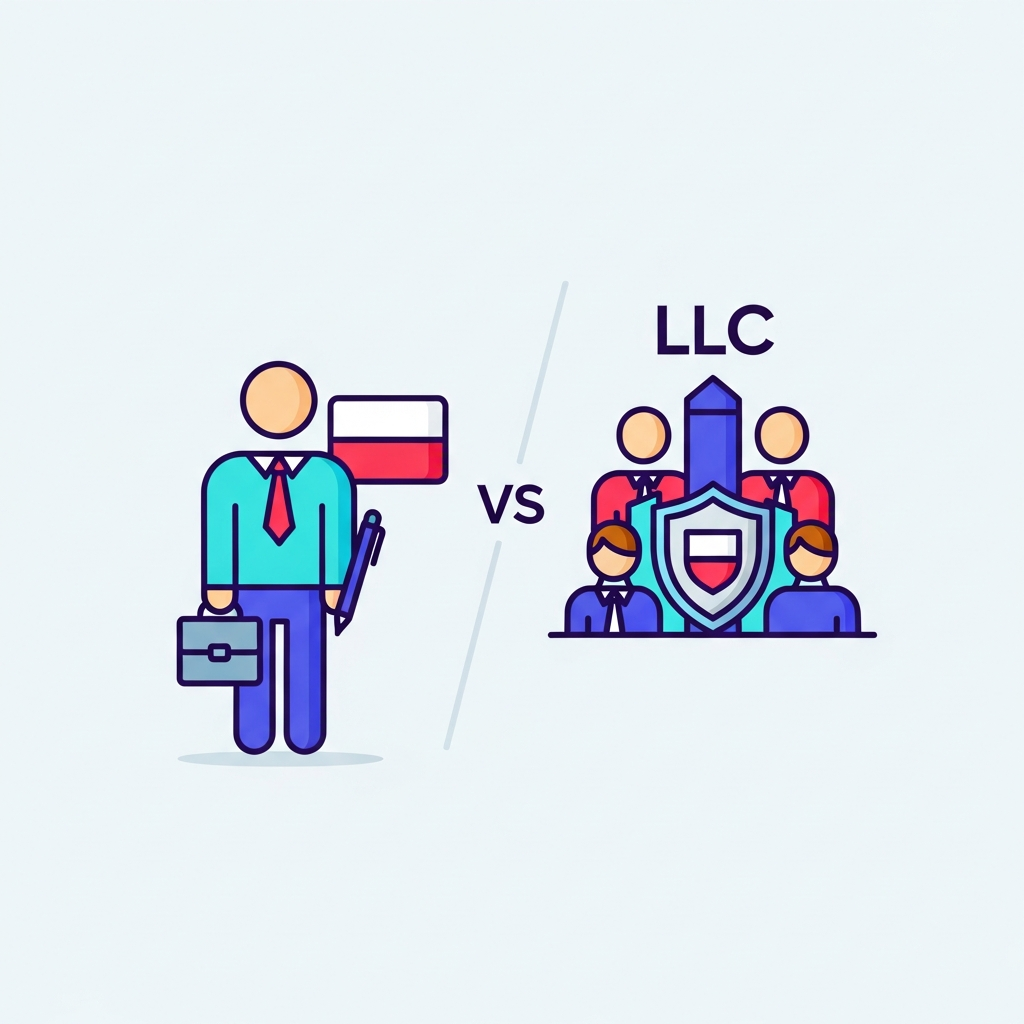
Sole Proprietorship vs. LLC in Poland: A Guide for Expat Freelancers
The Jednoosobowa Działalność Gospodarcza (JDG) Explained
The JDG is Poland’s sole proprietorship structure, offering a quick setup via the CEIDG registry and simplified bookkeeping, making it the default choice for individual freelancers. However, it legally ties your personal assets to your business liabilities.
Operating as an independent contractor in Central and Eastern Europe requires a solid legal foundation. Securing the right business vehicle determines your long-term financial success. The term Jednoosobowa Działalność Gospodarcza (JDG) will appear almost immediately upon arriving. This remains the absolute most popular structure for self-employed professionals entering the Polish market. It translates directly to a sole proprietorship. Setting it up takes very little time and involves minimal friction.
In our practice tracking CEE markets, we consistently see that expats prefer the JDG for its sheer administrative simplicity. Accessing the CEIDG registry online requires only a trusted profile (Profil Zaufany). The governmental system automatically notifies the tax office and the Social Insurance Institution (ZUS) on your behalf. Skipping the heavy bureaucratic lifting associated with registering corporate entities saves immense capital early on.
Bookkeeping for a JDG usually relies on a highly simplified revenue and expense ledger. Hiring an independent accountant costs roughly PLN 250 to 500 per month. They handle your monthly tax calculations and social security filings seamlessly. Keeping your administrative burden extremely low frees you to focus entirely on landing high-value contracts.
Who Qualifies for a Polish JDG?
Not every foreigner can simply log in and open a JDG immediately. Specific legal grounds are required to access the central registry. EU citizens enjoy the exact same setup rights as Polish nationals. They face zero restrictions regarding business registration and can start invoicing on day one.
Non-EU citizens face a much stricter reality on the ground. Holding a valid Pole’s Card, a permanent residence permit, or a specific business visa like the Poland Business Harbour is mandatory. Holding a standard work visa tied to a specific employer blocks you from legally operating a JDG. In those restrictive scenarios, exploring corporate structures becomes your only viable path.
VAT Registration and the White List
Registering for VAT acts as your next crucial step after formalizing the JDG. Poland mandates strict VAT registration once your sales exceed PLN 200,000 annually. Many B2B freelancers often register for VAT voluntarily from the very beginning anyway. Reclaiming VAT on heavy business purchases like high-end electronics, office furniture, and specialized software subscriptions boosts early cash flow.
Ensuring your business bank account appears on the government’s White List of Taxpayers (Biała lista podatników VAT) is equally critical. Polish B2B clients check this registry rigorously before paying any invoices exceeding PLN 15,000. Missing this registration causes clients to flatly refuse payment to avoid facing severe tax penalties themselves. Compliance here remains completely non-negotiable.
Personal Liability and the Flat Tax (Ryczałt) Model
In a JDG, you carry unlimited personal liability for business debts. To maximize income, most expat IT and consulting freelancers choose the Ryczałt flat tax model, which offers rates as low as 8.5% or 12%, though it restricts cost deductions.
Merging your legal identity and your business identity carries significant risks under a sole proprietorship. Signing all corporate contracts under your own name leaves you exposed. Creditors can legally pursue your private bank accounts, real estate, and physical assets if your business incurs heavy debt. Carrying this intense liability risk on your own shoulders requires careful operational management.
Freelancers usually accept this intense risk because the financial incentives remain highly attractive. The Polish government offers a specialized lump-sum tax model known directly as Ryczałt. Basing your income tax strictly on top-line revenue simplifies everything. Deducting business expenses like laptops, corporate travel, or software subscriptions becomes impossible. The sheer low percentage completely makes up for this restriction.
Understanding Ryczałt Rates in 2026
The Polish tax authority assigns specific Ryczałt rates based on your exact industry classification code (PKWiU). Software developers, programmers, and IT architects typically fall safely under the 12% rate. Management consultants and specialized marketing professionals often qualify for the lucrative 8.5% bracket. Some trade services might even drop to lower tiers depending on their scope.
Data from recent corporate setups shows that IT freelancers earning over PLN 20,000 monthly almost exclusively utilize the 12% Ryczałt model. Yielding a much higher net cash retention than the standard 19% flat tax makes it an easy choice. Accepting that massive equipment purchases will not lower your monthly tax bill is the only real trade-off.
Selecting your preferred taxation model must happen before the 20th day of the month following your first revenue generation. Making this strategic choice carefully is paramount. Changing your tax model midway through the fiscal year is legally impossible in Poland. Locking in your financial strategy dictates your profitability for the entire calendar year.
Alternative Tax Models for the JDG
High operational expenses can make Ryczałt hurt your overall profitability. Two other mainstream alternatives exist. The Progressive Tax Scale (Zasady Ogólne) taxes your income at 12% up to PLN 120,000, and 32% on everything above that threshold. Claiming a generous PLN 30,000 tax-free allowance annually softens the blow for lower earners.
Choosing the 19% Flat Tax (Podatek Liniowy) ignores income brackets entirely. Paying a steady 19% on your actual profit allows you to deduct all legitimate business costs. High-earning expats who purchase expensive servers, lease premium cars, or rent high-end office spaces typically gravitate toward this specific structure. Suppressing their taxable base becomes a full-time strategy.
The High Costs of ZUS Contributions for JDGs
In 2026, standard monthly ZUS social contributions (Duży ZUS) cost PLN 1,926.76. Adding the mandatory health contribution based on your income pushes the total baseline compliance cost well over PLN 2,300 per month for established freelancers.
Social security contributions represent the absolute largest fixed expense for sole proprietors operating in Poland. The Polish Social Insurance Institution (ZUS) strictly enforces these mandatory monthly payments without exception. Rising national average wages force these fixed statutory costs to scale up aggressively every single year. Evading them while maintaining an active business is legally impossible.
The projected average salary for 2026 dictates a standard social contribution base of PLN 5,652. Translating this directly results in roughly PLN 1,926.76 in hard monthly social security payments. Covering your mandatory pension, disability, and labor fund contributions consumes this massive chunk. Adding voluntary sickness insurance slightly increases this total. Owing this baseline cost regardless of your actual revenue that month breaks many new businesses.
Health Insurance Scaling on Ryczałt
Adding a mandatory health insurance premium strictly on top of your standard ZUS payments is unavoidable. Scaling dynamically across three distinct revenue brackets makes the Ryczałt health contribution complex. Earning more annually forces your monthly health premium to climb substantially.
Keeping your annual revenue below PLN 60,000 in 2026 means you pay PLN 498.35 monthly for health insurance. Crossing into the PLN 60,000 to PLN 300,000 bracket abruptly jumps the cost to PLN 830.58. Exceeding the steep PLN 300,000 ceiling pushes your monthly premium to a punishing PLN 1,495.04. Factoring this progressive cost jump into your annual cash flow forecasting is vital for survival.
Relief Programs for New Entrepreneurs
Softening the crushing blow of these high fixed costs relies on a brief honeymoon phase offered by the state. Utilizing the “Ulga na start” relief program shields new entrepreneurs. Granting a full six months of complete exemption from the heavy social contributions provides massive relief. Paying only the minimum mandatory health insurance premium during this crucial initial runway keeps capital inside the business.
Transitioning automatically into the “Preferential ZUS” tier happens after six months. Dropping your social contributions significantly for the next 24 months relies on a calculation based strictly on 30% of the minimum wage. Sitting at around PLN 456.19 monthly in 2026, this preferential social payment is highly manageable. Enjoying two and a half years of discounted operations allows you to build a client base before facing the full financial weight of the Duży ZUS burden.
Facing a slow year might qualify you for the Mały ZUS Plus program. Targeting smaller operations generating less than PLN 120,000 in annual revenue, this initiative recalculates your monthly contributions proportionally to your actual income from the previous year. Utilizing this lifeline for up to 36 months provides critical breathing room during severe economic downturns.
Why B2B Enterprises Prefer Contracting LLCs
European enterprises prefer contracting a Polish LLC (Sp. z o.o.) over a JDG to mitigate hidden employment risks and ensure corporate liability protection. A Spółka z o.o. shields personal assets while offering clear B2B vendor legitimacy.
Hitting a sharp growth ceiling while operating as a simple sole proprietor frustrates many foreign freelancers. Scrutinizing their vendor supply chains incredibly heavily is standard practice for large Western European corporations. Fearing disguised employment regulations drives their procurement decisions. Violently reclassifying the relationship by local tax authorities happens if a freelancer acts exactly like an internal employee. Triggering massive retroactive tax penalties for the hiring enterprise kills contracts instantly.
We routinely advise clients during cross-border contract negotiations, and procurement departments explicitly favor limited liability companies every single time. Creating an undeniable, hard B2B boundary is exactly what a Polish Spółka z o.o. does. Signing a binding contract with an independent legal entity protects the enterprise. Neutralizing their disguised employment risk completely secures your recurring revenue.
The Protection of the Spółka z o.o.
Altering your operational risk profile drastically is the primary benefit of a limited liability company. Keeping your personal assets completely separate from the corporate balance sheet lets you sleep at night. Suing your company for a data breach or a failed project deliverable cannot touch your personal savings. Stopping dead at the company’s registered share capital, the legal liability is securely contained.
Registering the LLC legally requires a strict minimum share capital of PLN 5,000. Drafting complex articles of association and utilizing the National Court Register (KRS) defines the setup process. Transitioning rapidly from a simple ledger to rigorous full double-entry bookkeeping increases operational friction. Expecting your monthly accounting fees to start around PLN 1,000 to PLN 2,500 is realistic due to the massive specialist shortage in the accounting sector.
Corporate Oversight and Liability Nuance
Mistaking limited liability for total immunity remains a dangerous rookie error. Strict provisions governing corporate oversight exist deeply within Polish law. Facing personal liability for company debts under Article 299 of the Commercial Companies Code threatens negligent Management Board members. Applying this severe penalty only happens if the board fails to file for bankruptcy promptly when the company becomes fully insolvent. Actively monitoring your corporate financial health prevents this disaster.
Mandatory registration in the Central Register of Beneficial Owners (CRBR) adds another layer of strict compliance. Enforcing aggressive anti-money laundering (AML) laws across all corporate structures remains a government priority. Failing to report the ultimate human owners of your LLC within the statutory deadline results in massive financial fines. Maintaining the corporate shield requires constant, vigilant administrative effort.
Bypassing ZUS and Managing Corporate Tax
Structuring a Spółka z o.o. to completely bypass the crushing monthly ZUS payments entirely is a common advanced strategy. Operating with at least two legitimate shareholders frees the partners from paying standard social security contributions. Creating this fascinating financial arbitrage opportunity changes the math. Trading higher accounting costs for total freedom from the ZUS apparatus yields a massive net positive over five years.
Extracting money from an LLC intelligently requires deep strategic planning. Facing Corporate Income Tax (CIT) at the company level typically hits a 9% preferential rate for small taxpayers. Triggering a secondary 19% tax occurs when paying yourself traditional dividends. Aggressively mitigating this by utilizing the Estonian CIT model defers taxation entirely until funds formally exit the company, creating massive reinvestment power.
Comparing the Financial Baseline (2026)
| Business Structure | Setup Time | Monthly Accounting Fees | Monthly ZUS (Standard 2026) | Liability Profile |
|---|---|---|---|---|
| JDG (Sole Proprietorship) | 1-2 Days (Online via CEIDG) | PLN 250 – 500 | PLN 1,926.76 + Health Premium | Unlimited Personal Liability |
| Spółka z o.o. (LLC) | 3-7 Days (Online / Notary) | PLN 1,000 – 2,500 | None (if multi-shareholder) | Limited to Corporate Assets |
Defining your entire operational reality in Poland comes down to choosing between these two structures. Keeping your cash flow fast and your paperwork light makes the JDG ideal for independent coders and consultants. Demanding serious overhead and rigorous compliance, the LLC delivers unparalleled security and scalability when you start landing major enterprise contracts.
Frequently Asked Questions (FAQ)
Below are the most common questions regarding the choice between a Polish sole proprietorship and a limited liability company for foreign freelancers. Review these essential details to finalize your exact compliance strategy.
Can a foreigner open a JDG in Poland?
Yes, if you hold a valid Pole’s Card, permanent residency, or specific business visas (such as the Poland Business Harbour). Non-EU citizens without these specific documents must typically register an LLC instead.
What is the minimum capital required for an LLC in Poland?
A Polish Sp. z o.o. requires a strict minimum share capital of PLN 5,000. You must officially deposit this exact amount into the corporate bank account immediately upon registration.
Does an LLC pay double taxation in Poland?
Yes, an LLC pays Corporate Income Tax (CIT) at 9% or 19% on generated profits, and shareholders pay a 19% dividend tax upon withdrawal. However, the Estonian CIT model can effectively defer and lower this burden.
How long does it take to register a business in Poland?
You can successfully register a JDG within 24 hours entirely online via the CEIDG portal. A standard Spółka z o.o. registration via the S24 online system typically takes 3 to 7 business days to finalize.