Demographics and the Labor Shortage: CEE’s Biggest Economic Threat
The Aging Population and Shrinking Workforce
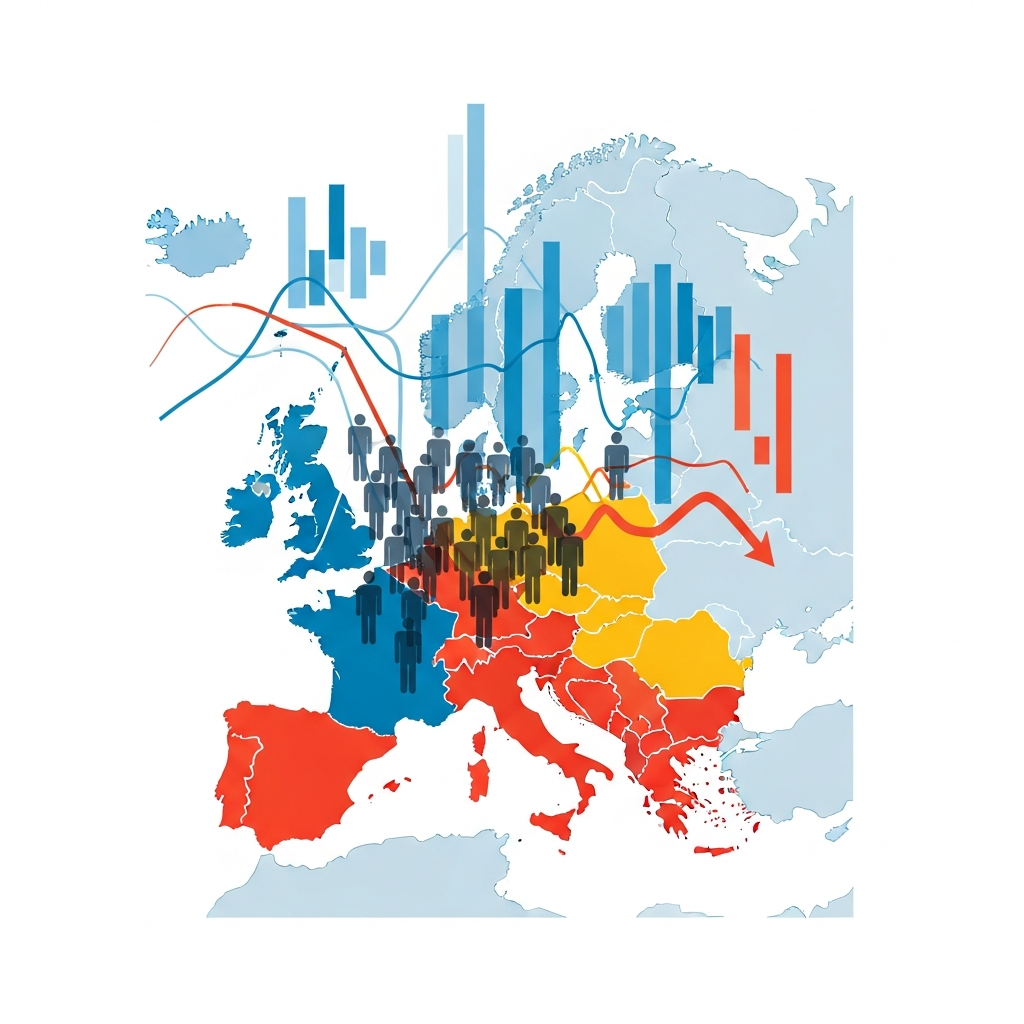
The shrinking CEE workforce is an acute structural deficit driven by a plunging birth rate and rapid aging, creating an estimated shortfall of 1.5 million workers in Poland alone by 2026.
Demographic collapse is no longer a distant theoretical risk. The region faces a massive contraction in working-age citizens. Birth rates across Central and Eastern Europe sit near historic lows, heavily trailing replacement levels. Low fertility coupled with steady youth emigration has stripped the labor pool of fresh talent.
In our practice tracking CEE markets, corporate clients frequently rank labor availability as their primary expansion barrier. Statistics Poland confirmed that by the end of Q1 2026, job vacancies surpassed 100,000 despite overall corporate employment contracting. Companies fiercely compete for a diminishing pool of local professionals.
Sector-Specific Vacancy Crises
Manufacturing endures the highest number of unfilled positions. Over 20,500 vacancies plague the industrial sector, severely limiting factory output. Assembly lines lack machine operators, while critical maintenance teams operate chronically understaffed.
Construction faces similar hurdles. Aging tradespeople retire faster than vocational schools can produce replacements. Nearly seven out of ten construction firms report project delays strictly tied to a lack of skilled personnel.
The transport sector struggles equally. Haulage companies frequently park commercial trucks simply because they lack licensed drivers. The demographic cliff guarantees that retiring truck drivers will not be replaced by young domestic applicants, threatening the entire regional supply chain.
The Limits of Wage Inflation
Raising salaries no longer solves the underlying headcount problem. Businesses aggressively hiked wages throughout 2024 and 2025 to poach talent from competitors. This tactic simply shuffled the same small group of workers between different employers.
Wage inflation erodes profit margins without expanding the total labor supply. Regional inflation pressures have eased, yet salary demands remain high. Employers hit a financial ceiling where throwing money at the shortage yields zero operational return.
Smaller enterprises fold under this constant wage pressure. Multinational corporations absorb the higher payroll costs, bleeding local competitors dry. Consequently, market consolidation accelerates as smaller firms capitulate to the impossible economics of bidding wars.
Urban vs. Regional Discrepancies
Major metropolitan hubs like Warsaw hide the true severity of the crisis. Warsaw maintains the highest job vacancy rate at 1.11%, but foreign migration masks the local deficit. Over 240,000 foreign nationals currently work in the capital.
Smaller industrial cities bear the brunt of demographic decline. Secondary markets rely entirely on native labor, which is rapidly graying. Factories located outside major transport corridors struggle daily to staff basic operational shifts.
Immigration Policy and Ukrainian Integration
Immigration policy in 2026 centers on retaining the Ukrainian workforce by transitioning temporary protection status into long-term economic integration through language and credential upskilling programs.
Over 850,000 Ukrainians currently maintain legal employment in Poland. They represent the unquestionable backbone of the regional foreign workforce. Early emergency measures enacted in 2022 have evolved into permanent structural reliance.
We consistently see that ad-hoc hiring strategies fail when companies ignore long-term retention pathways for displaced professionals. While 69% of working-age Ukrainian refugees actively participate in the labor force, many remain trapped in survival jobs. Strategic integration demands moving these individuals into roles that match their actual expertise.
Addressing the Skills Mismatch
Unrecognized qualifications artificially suppress economic output. Highly educated engineers and medical professionals frequently resort to manual labor. State bureaucracies slow down the credential validation process, wasting vital human capital.
Employers must bridge this gap independently. Forward-thinking firms invest heavily in fast-track internal training and dedicated Polish language courses. Upward mobility for foreign workers directly stabilizes corporate retention rates.
Private recruitment agencies increasingly act as career mediators. They partner with universities to fast-track nursing and engineering equivalency exams. Bypassing state bottlenecks through privatized upskilling delivers immediate value to corporations desperate for licensed talent.
Childcare and Workforce Participation
Female refugees face massive barriers to full-time employment. Insufficient access to affordable childcare forces many skilled women into part-time or informal roles. You cannot maximize this labor pool without solving the logistical challenges of motherhood.
Corporate onsite daycare initiatives are gaining traction. Companies offering flexible hours and childcare stipends easily attract top Ukrainian talent. Solving this specific friction point unlocks thousands of available working hours across the economy.
Community integration plays a critical hidden role. When schools lack bilingual assistants, refugee children struggle, forcing parents to scale back working hours. Funding municipal education initiatives directly translates to higher immigrant workforce reliability.
Legislative Frameworks for Long-Term Stay
Temporary protection mechanisms require permanent legal upgrades. The Polish government is actively drafting pathways to transition refugees into standard residence permits. Ambiguity surrounding legal status historically prevents immigrants from securing mortgages or signing long-term employment contracts.
Providing regulatory certainty stabilizes the entire labor market. Workers commit to multi-year corporate projects only when they feel geographically secure. Legislative clarity directly reduces annual employee turnover metrics.
Sourcing Talent from Asia and the Global South
Sourcing talent from the Global South involves recruiting skilled workers from countries like India, Colombia, and the Philippines to fill widening gaps in logistics, manufacturing, and IT.
Data from recent corporate setups shows a massive pivot toward non-European labor pools to staff distribution centers and production lines. Polish employers exhausted the available workforce from neighboring Eastern European states. By late 2025, the total number of legally employed foreigners surged past 1.29 million.
Workers from Asia and South America arrive with long-term settlement intentions. They view the CEE region as a primary destination rather than a temporary stopover. This psychological shift offers companies a highly stable, dedicated workforce.
Navigating Strict Visa Reforms in 2026
Hiring from distant markets introduces severe administrative friction. Visa processing fees jumped sharply on January 1, 2026. A national D-type visa now costs €200, while Schengen visas sit at €90.
Higher fees provide zero guarantee of faster consular processing. Employers face mounting delays lasting several months just to deploy a single technician. Corporate HR departments must factor these extended timelines into their annual capacity planning.
Logistics and Warehouse Dependencies
Supply chain infrastructure runs heavily on international labor. The logistics sector currently claims roughly 20% of all issued foreign work permits. Warehouses in central Poland operate 24/7 relying on teams from Nepal, Bangladesh, and India.
Without these global recruits, e-commerce fulfillment would collapse. Native workers actively avoid the physical strain of order picking and inventory management. Importers constantly lobby for streamlined visa lanes to keep distribution networks functioning.
2026 Visa and Work Permit Constraints in Poland
| Legal Mechanism | 2026 Update / Cost | Primary Target Regions | Processing Reality |
|---|---|---|---|
| National D-Type Visa | €200 (Increased Jan 1) | Asia, South America | Subject to severe, multi-month consular backlogs. |
| Declaration of Entrustment | 400 PLN | Armenia, Belarus, Moldova, Ukraine | Fast-track processing but restricted to four nations. |
| Schengen Visa Transfer | Blocked (Effective June 1) | Workers entering via CZ/SK | Immediate rejection for local Polish work permits. |
| Seasonal Work Permit | 100 PLN | Global Agricultural Workers | Strictly limited to farming and seasonal hospitality. |
The June 1st Schengen Blockade
Legal loopholes closed tightly this summer. Poland enacted strict amendments to Article 116 of the Act on Foreigners on June 1, 2026. Authorities now automatically reject work permit applications from individuals residing on visas issued by other Schengen states.
You can no longer borrow labor entering through Slovakia or the Czech Republic. Companies must sponsor their workforce directly through Polish national immigration channels. This eliminates gray-market agency practices and forces strict corporate compliance.
Automation as an Economic Imperative
Automation is the strategic deployment of robotics and intelligent software to maintain regional industrial output without relying on a human headcount that no longer exists.
Firms cannot hire their way out of a demographic black hole. Capital investment must actively replace missing manual labor. Warehouses and factories aggressively adopt autonomous mobile robots and automated storage systems.
Replacing missing forklift operators represents a basic survival tactic, not a futuristic luxury. The sheer lack of available physical bodies forces rapid technological adoption. Businesses failing to automate face immediate production bottlenecks.
Robotics in Manufacturing and Warehousing
Industrial robotic arms handle dangerous and repetitive assembly tasks. Smart conveyor systems sort packages instantly, removing the need for massive sorting crews. E-commerce giants currently design entirely dark warehouses that operate with minimal human intervention.
Cobots, or collaborative robots, work directly alongside human employees. They multiply the output of a single worker by handling heavy lifting and precision placement. This hybrid approach maximizes the value of your limited remaining staff.
Predictive maintenance sensors further reduce human dependency. Machines monitor their own wear and tear, alerting engineers before a catastrophic breakdown occurs. This eliminates the need for large, manual inspection crews walking the factory floor.
Artificial Intelligence in Administrative Roles
Labor shortages extend deep into white-collar territory. AI-driven software handles complex inventory forecasting, invoice processing, and baseline customer service. Algorithms eliminate the need for bloated mid-level administrative departments.
Human workers shift toward analytical oversight and strategic maintenance roles. You secure a massive competitive edge by decoupling operational capacity from local demographic constraints. Software scales instantly; human hiring does not.
Government Subsidies for Digital Transformation
State agencies recognize that automation secures national economic stability. Regional development funds heavily subsidize companies investing in smart manufacturing. Tax incentives reward the integration of Industry 4.0 technologies.
Grants specifically target small and medium enterprises struggling to afford initial capital outlays. Leveraging these public funds drastically reduces the return on investment timeline. Modernizing your physical infrastructure is heavily discounted if you navigate the grant landscape correctly.
Early adopters capture the lion’s share of this institutional funding. Bureaucratic application windows close rapidly once annual budgets drain. Securing state backing requires decisive action and airtight project documentation.
Frequently Asked Questions (FAQ)
This FAQ provides direct, factual answers to the most common inquiries regarding the 2026 Central and Eastern European labor market shortages and corresponding regulatory shifts.
What is the projected labor shortage in Poland by 2026?
Poland faces a structural deficit of approximately 1.5 million workers. Despite low unemployment, official statistics recorded over 100,000 job vacancies in the first quarter, predominantly crippling the manufacturing, logistics, and construction industries.
How have Polish visa fees changed this year?
Effective January 1, 2026, the Polish government increased the fee for a national D-type visa to €200. Schengen visa applications concurrently rose to €90, significantly raising the upfront cost of importing foreign labor.
Can foreign workers use other Schengen visas to work in Poland?
No. On June 1, 2026, an amendment to Article 116 of the Act on Foreigners took effect. This law explicitly blocks individuals from legalizing employment in Poland if they rely solely on visas or residence permits issued by other Schengen states.
Which global regions supply the most labor to CEE markets?
With local Eastern European pools exhausted, employers heavily target Asia and South America. Workers from India, Colombia, the Philippines, Nepal, and Bangladesh currently represent the fastest-growing demographics filling essential logistics and production roles.