Why Germany is Betting Big on Polish Nearshoring Operations in 2026
Breaking Down the 56% Investment Intention Rate
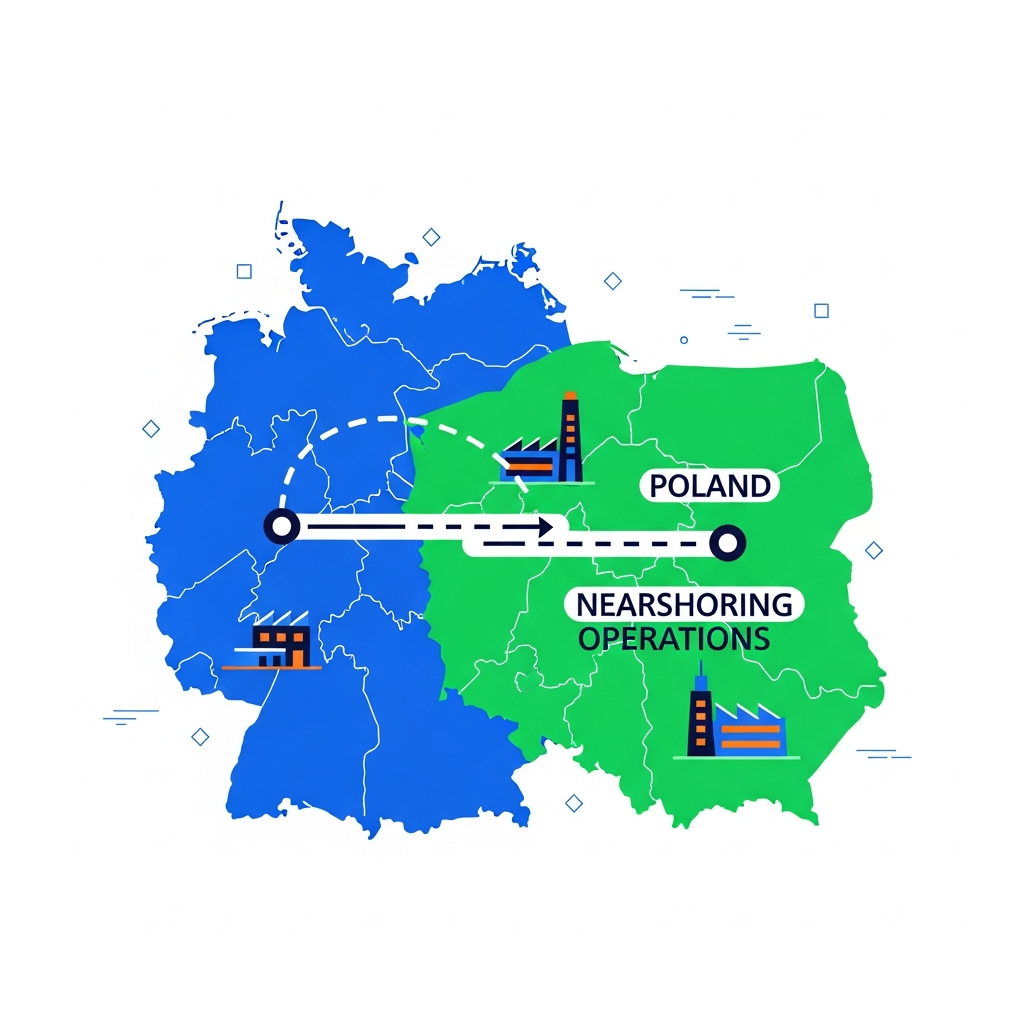
A 2026 survey confirms that 56% of German firms planning Central and Eastern European investments select Poland as their primary destination. This metric highlights a definitive strategic shift toward high-growth, predictable European markets.
The current macroeconomic environment heavily favors geographical proximity over distant alternatives. German decision-makers recognize that long-distance offshoring carries hidden risks that erode initial cost savings. Poland offers unparalleled market stability. The country boasts an estimated 2026 GDP growth of 2.9%, vastly outpacing Germany’s 0.9% projection.
In our practice tracking CEE markets, corporate leaders frequently prioritize intellectual property protection over absolute cost reduction. The data reveals that Poland delivers an unmatched combination of technical talent density and strict European Union compliance. Executives quickly realize that shared legal frameworks eliminate the severe friction associated with foreign contract enforcement.
Poland boasts a highly educated workforce. The market includes over 580,000 IT professionals representing roughly a quarter of the region’s tech talent. Your organization can seamlessly tap into this specialized labor pool. Traditional hiring approaches in Western Europe face an unprecedented squeeze, making cross-border talent acquisition a strategic necessity.
The Financial Mechanics of the Shift
The standard Polish Corporate Income Tax (CIT) rate remains fixed at 19% in 2026. A reduced 9% rate applies to small taxpayers whose current-year revenue strictly excludes capital gains and stays below PLN 8,431,000. These transparent tax policies simplify financial forecasting for cross-border operations.
Employment costs require precise calculation to evaluate nearshoring feasibility accurately. The gross minimum wage now stands at PLN 4,806 per month. Employers must budget for total costs reaching approximately PLN 5,790 per minimum-wage worker after social contributions. Exceptional value generated by Polish engineers easily justifies the capital outlay.
Talent Quality and Cultural Alignment
Quantity without quality means nothing in complex engineering or manufacturing environments. Poland graduates over 15,000 computer science students annually. This feeds a continuous pipeline of junior and mid-level expertise. Your technical directors will appreciate the exceptional English proficiency and rigorous academic standards embedded in the local culture.
Deep integration with Western business norms creates natural alignment regarding professional interaction and problem-solving approaches. Time zone compatibility ensures that agile development teams collaborate in true real-time. Managers avoid the grueling early morning or late-night synchronization calls that notoriously burn out offshore directors.
Supply Chain De-risking from Asian Markets
Supply chain de-risking involves relocating critical production and procurement closer to domestic markets to neutralize geopolitical and logistical threats. Currently, 67% of German companies source materials from the CEE region.
Heavy reliance on distant Asian suppliers previously exposed Western manufacturers to severe logistical bottlenecks. Volatile freight costs routinely damaged profit margins. Bringing operations across the Oder river slashes transit times from several weeks to mere hours. You instantly secure your critical supply lines against unforeseen maritime shipping delays.
Data from recent corporate setups shows a massive transition toward the Build-to-Operate model in Polish industrial hubs. German firms aggressively secure modern, highly automated warehouse spaces to buffer inventory efficiently. Market conditions here permit profit margins and capital turnover rates that remain mathematically impossible in heavily regulated Western European zones.
Shorter and highly predictable administrative procedures give developers the operational flexibility required to construct advanced facilities quickly. Projects in Poland benefit from lower capital expenditure requirements due to faster development cycles. Your procurement division achieves a superior risk-to-reward ratio by localizing production within a few hundred kilometers of the final assembly plants.
The End of Pure Cost Arbitrage
Nearshoring no longer revolves solely around chasing the lowest possible hourly wage. Advanced automation and robotics require highly skilled technicians to manage and maintain the assembly lines. Polish special economic zones offer robust tax incentives for investors who deploy modern, green technologies rather than merely exploiting cheap manual labor.
Intellectual property theft remains a massive concern when manufacturing proprietary components in distant offshore jurisdictions. Moving production to Poland ensures strict adherence to European data protection standards and patent laws. Your legal department spends less time fighting infringement and more time securing strategic partnerships.
| Operational Metric | Polish Nearshoring | Asian Offshoring |
|---|---|---|
| Logistics Transit Time | 12 – 48 hours (Overland) | 30 – 45 days (Sea Freight) |
| Data Security & Privacy | Strict EU GDPR Compliance | Highly variable by jurisdiction |
| Time Zone Difference | None (CET/CEST) | +6 to +8 hours difference |
| Intellectual Property Risk | Very Low (EU Directives) | Moderate to High Risk |
| ESG Reporting Ease | High (EU Taxonomy aligned) | Complex and often opaque |
Environmental, Social, and Governance (ESG) Advantages
The European Union’s stringent ESG reporting directives force corporations to audit their entire supply chains rigorously. Sourcing materials and components from Poland dramatically reduces Scope 3 carbon emissions associated with long-haul ocean freight. You immediately improve your corporate sustainability metrics by localizing the procurement network.
Labor rights and workplace safety standards in Poland mirror those found in Germany. Auditing a supplier located two hours from Berlin requires significantly less effort than inspecting a factory on another continent. Compliance officers can conduct surprise site visits easily, ensuring total transparency across the manufacturing process.
Infrastructure Interoperability at the Border
Infrastructure interoperability refers to the seamless, frictionless integration of transport, energy, and digital networks between Germany and Poland. This physical and virtual connectivity enables highly synchronized cross-border industrial operations.
Bilateral trade between the two nations reached an astonishing EUR 180.6 billion recently. This cements Poland as a top-tier trade partner. Roads and railways now handle immense volumes of cargo with absolute predictability and tracking transparency. Your logistics teams can monitor critical shipments across borders with zero technical friction or customs delays.
We consistently see that digital infrastructure matches the physical transport capabilities blow for blow across the border. Poland offers deep fiber-optic penetration and widespread 5G coverage across its major industrial and technological hubs. Cloud networks sync effortlessly with German headquarters, entirely eliminating the latency issues that plague traditional offshore communication channels.
The integration of power grids provides essential redundancy for energy-intensive manufacturing operations. Reliable, uninterrupted power supply dictates the success of factories running automated, round-the-clock assembly lines. You avoid the catastrophic blackout risks that frequently paralyze production in less developed nearshore destinations.
Seamless Legal and Financial Integration
Operating across the Polish-German border requires navigating two distinct tax systems. The friction remains minimal, however. Both countries operate within the Single Euro Payments Area (SEPA), enabling instant, low-cost financial transfers. Your treasury department can manage cash flow and payroll operations without worrying about volatile currency controls.
Cross-border contract law operates under familiar European Union directives. These standardise liability, warranties, and dispute resolution. Legal teams draft agreements knowing that Polish courts respect and enforce international commercial arbitration awards. Businesses expand their footprint confidently when the legal foundation remains solid and highly predictable.
Talent Mobility and Border Logistics
The Schengen Area guarantees the free movement of professionals between the two countries. German engineers and executives commute to Polish facilities weekly without visas, passport checks, or administrative hurdles. You can deploy specialized strike teams to solve sudden manufacturing issues in hours rather than days.
Freight forwarders optimize routes using advanced telematics that communicate directly with regional traffic control systems. Smart border checkpoints utilize automated license plate recognition to process commercial vehicles instantly. Delivery trucks maintain exact Just-In-Time (JIT) schedules, feeding German assembly lines precisely when the components are required.
Case Studies in Automotive and Manufacturing
Leading automotive and industrial manufacturing entities establish advanced Polish facilities to produce complex electric vehicle components and precision machinery. These strategic investments shift the operational focus entirely from basic assembly to high-value engineering.
One major nearshoring project involves scaling electric vehicle battery production near the western Polish border. The facility heavily leverages Poland’s educated engineering graduates to optimize chemical processing and automated assembly speeds. Your competitors already utilize this exact talent pipeline to accelerate research and reduce the time-to-market for new models.
Another prominent example centers on precision industrial machinery and robotics. Engineers collaborate in real-time across the border without the slightest delay in communication. The Polish development teams handle both complex software architecture and rigorous hardware testing. This proves the region delivers massive intellectual value.
Western investors discover that capital deployment generates returns much faster in the Polish market. Construction timelines for new manufacturing plants average significantly less than comparable projects in Germany. Rapid facility deployment translates directly into faster revenue generation and aggressive market share expansion.
Transforming Operational Models
Successful nearshoring requires viewing the Polish branch as a fully integrated strategic partner rather than a subordinate cost center. Assimilation of corporate cultures happens naturally due to shared work ethics and Western business practices. You achieve maximum operational efficiency when local directors possess the autonomy to optimize internal workflows.
German managers historically attempted to micromanage Eastern European branches. This led to severe friction and high turnover. The modern approach involves setting strict performance metrics while allowing Polish teams to determine the execution methods. Trusting local expertise unlocks innovative problem-solving that rigid, top-down management structures typically stifle.
The Student Housing and Real Estate Boom
Industrial expansion directly drives the commercial and residential real estate sectors. Developers pivot aggressively toward Student Housing and Build-to-Rent models to accommodate the massive influx of domestic and international talent. Providing premium living spaces helps tech companies and manufacturers attract the highest tier of university graduates.
Investors shift their logic from short-term development sales toward securing stable operational income and long-term asset value. Poland demonstrates the unique capacity to scale this sector faster and far more efficiently than saturated Western markets. You capitalize on this demographic trend by securing corporate housing blocks for your expanding nearshore workforce.
Frequently Asked Questions (FAQ)
This section provides authoritative, factual answers regarding Polish nearshoring operations, tax obligations, and labor costs for the 2026 fiscal year.
What is the exact minimum wage in Poland in 2026?
The statutory minimum wage in Poland for 2026 is PLN 4,806 gross per month. This rate remains fixed for the entire calendar year, providing employers with absolute budgeting stability without unexpected mid-year hikes.
What corporate tax rates apply to foreign companies in Poland?
The standard Corporate Income Tax (CIT) rate in Poland is 19%. Small taxpayers and new entities with current-year revenue strictly below PLN 8,431,000 qualify for a reduced 9% rate on operational income.
How large is the available IT talent pool in Poland?
Poland hosts a massive workforce of over 580,000 IT professionals in 2026. This highly educated group represents approximately 25% of the entire technology talent pool across Central and Eastern Europe.
Why do German manufacturers prefer Poland over Asian offshoring?
German firms choose Poland to eliminate severe supply chain bottlenecks and guarantee strict EU regulatory compliance. Geographic proximity slashes transit times from several weeks by sea freight to mere hours by overland truck transport.