Foreign Ownership of Real Estate in Poland: Permits and Restrictions
The Act on the Acquisition of Real Estate by Foreigners
The 1920 Act strictly regulates how non-citizens buy property in Poland, explicitly defining when you need formal government permission versus when you can purchase freely.
Historical Context and 2026 Legal Realities
This primary legal framework dictates all foreign property transactions across the nation. It aims to protect national security and public order while maintaining an open investment market. You will encounter its rigid rules immediately when initiating any real estate deal.
In our practice tracking CEE markets, we notice regulators applying increasingly intense scrutiny to property transfers. The geopolitical shifts of recent years forced authorities to tighten internal security protocols. You face a highly regulated environment that demands absolute compliance.
Ignoring this legislation leads to instantly nullified contracts. Buyers who attempt to bypass the law lose their invested capital and face severe administrative penalties. You must verify your exact legal standing before signing any preliminary agreement.
Defining a “Foreigner” Under Polish Law
The statute defines a foreigner as any natural person lacking Polish citizenship. It also covers corporate entities headquartered abroad or local companies controlled by foreign capital. Indirect control through complex shareholding structures falls under heavy surveillance.
Regulators pierce the corporate veil to find the ultimate beneficial owner. You cannot hide behind a local limited liability company if a non-EU citizen holds the majority voting rights. The local entity will still require full ministerial approval.
A partnership without legal personality formed abroad also triggers the same restrictions. Polish law looks at the actual decision-makers rather than just the registered office address. You need absolute transparency regarding the source of your funds.
The Role of the Polish Notary Public
The notary public acts as the primary gatekeeper for the state. They hold the ultimate responsibility to block unlawful property transfers before they finalize. A notary will simply refuse to draft the final deed if you lack the required permit.
You rely entirely on the notary to assess the legal status of the land register. They execute the mandatory anti-money laundering (AML) checks required by the 2026 financial directives. Expect rigorous questioning about your wealth generation.
Differences Between EU/EEA and Non-EU Investors
Citizens of the EU, EEA, and Switzerland enjoy identical purchasing rights to Polish nationals, whereas non-EU investors face strict permit requirements for specific asset classes.
The Seamless EU/EEA Purchasing Experience
European integration completely reshaped the local property landscape for regional neighbors. If you hold a passport from an EU member state, Norway, Iceland, Liechtenstein, or Switzerland, the market treats you like a local buyer. You skip the cumbersome administrative hurdles entirely.
These buyers purchase standalone houses, commercial plots, and apartments without any special government clearance. They only face the standard limitations applied to Polish citizens, specifically regarding agricultural land. You experience a smooth, fast transaction process.
Banks offer EU citizens the exact same mortgage rates and conditions as domestic borrowers. You do not need to provide proof of permanent ties to Poland to secure financing. The financial sector views your European passport as a guarantee of legal stability.
Non-EU Corporate Entities and Beneficial Owners
Non-EU buyers operate under a highly regulated and scrutinized regime. You can freely buy an independent residential apartment in major cities like Warsaw or Wrocław. However, acquiring a freestanding house or any land parcel automatically triggers a mandatory government review.
Data from recent corporate setups shows that many non-EU developers establish local entities to streamline acquisitions. Yet, Polish authorities aggressively trace the ultimate beneficial owner. If a non-EU individual directs the board, the company must secure an MSWiA permit.
We consistently see that attempting to bypass the system via proxy buyers triggers criminal investigations. Authorities use advanced financial tracing to link property purchases back to their true foreign funders. You must operate entirely above board to protect your asset.
Identifying Border Zones and Strategic Areas
Location drastically alters your legal purchasing power. The Polish government defines a specific “border zone” that includes entire coastal cities like Gdańsk and Gdynia. Buying any real estate inside these zones requires a permit, even for a basic apartment.
Strategic areas near military bases or critical infrastructure face absolute restriction. The Internal Security Agency flags transactions occurring near ports, airports, and energy hubs. You should map your desired location against the official border zone registry immediately.
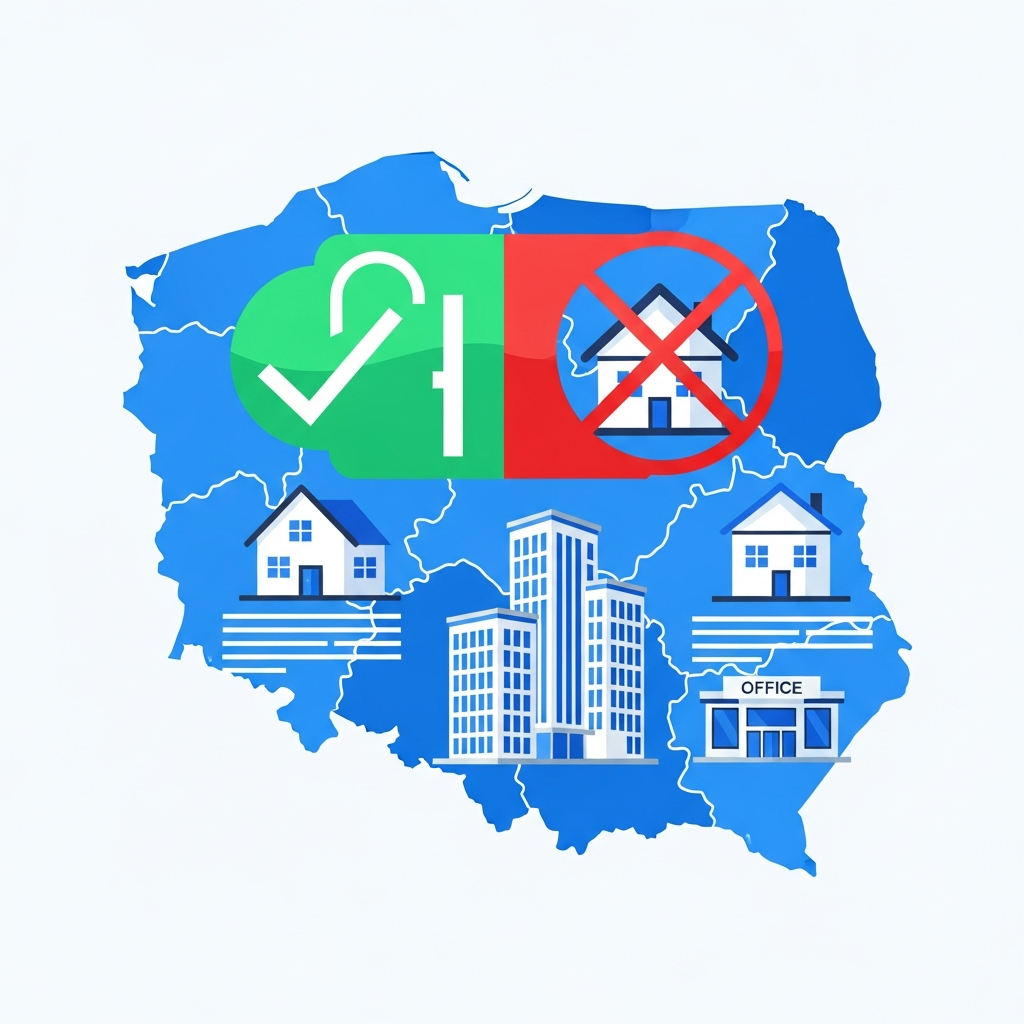
| Property Type | EU / EEA / Swiss Buyers | Non-EU Buyers (Inland) | Non-EU Buyers (Border Zone) |
|---|---|---|---|
| Independent Apartment | No permit required | No permit required | Permit required |
| House with Land Plot | No permit required | Permit required | Permit required |
| Commercial Office Space | No permit required | No permit required | Permit required |
| Agricultural Land (>0.3 ha) | Subject to KOWR limits | Permit + KOWR limits | Permit + KOWR limits |
Agricultural Land vs. Commercial/Residential Property
Residential apartments bypass government scrutiny, while agricultural plots over 0.3 hectares face extreme restrictions designed to protect domestic farming resources from foreign speculation.
The Simple Path of Residential Apartments
Buying an apartment in a multi-unit building remains the easiest path into the market. You simply sign the notarial deed and register your ownership at the local court. The law classifies this as a separate ownership right, exempt from general land restrictions.
You can also purchase an underground garage space associated with your apartment. As long as the garage serves your residential needs, it falls under the same exemption. You avoid the permit process entirely in standard inland cities.
Property tax on standard residential apartments remains incredibly low across the country. You will typically pay between 100 and 600 PLN annually for a standard unit. This makes urban apartments highly attractive for foreign capital placement.
Why Standalone Houses Trigger Stricter Scrutiny
We regularly advise clients that purchasing a standalone house involves buying the underlying land plot. This structural reality instantly triggers the Ministry review for non-EU buyers. You cannot simply separate the building from the dirt it sits on to avoid the paperwork.
Townhouses and semi-detached homes usually fall into this restricted category as well. You acquire a fractional share of the ground beneath the structure. The moment land ownership transfers, the MSWiA demands oversight.
You must factor a significant waiting period into your purchase timeline. Sellers often refuse to wait six months for a foreign buyer to clear the administration. You need to negotiate extended preliminary contracts to secure the property safely.
Commercial Real Estate and Investment Portfolios
Commercial properties follow a nuanced set of regulations based on their legal structure. Buying a standalone commercial building requires full ministerial approval. You are buying the land beneath the shop or warehouse.
Conversely, purchasing an independent commercial unit inside a larger mall does not require a permit. The legal distinction mirrors the residential apartment exemption. Many foreign investors target these commercial strata units for hassle-free yield generation.
Large-scale warehouse logistics and industrial parks dominate the CEE investment landscape. Foreign institutional funds structure these deals via complex share purchases. You must secure clearance if your acquisition results in a foreign entity controlling the land-owning company.
Extreme Barriers in the Agricultural Sector
Agricultural real estate operates in a completely different legal universe. The 2003 Act on Shaping the Agricultural System applies aggressively alongside standard foreigner restrictions. Even Polish citizens face high barriers when buying farmland today.
The National Support Centre for Agriculture (KOWR) holds pre-emption rights over almost all rural plots. You must prove actual farming qualifications to purchase land exceeding 0.3 hectares. Foreigners encounter double the compliance load when entering this sector.
Converting agricultural land to construction status requires years of administrative battling. You should never buy cheap rural land expecting a quick flip into a housing development. The state protects arable land with ruthless legal efficiency.
The Ministry of Interior Approval Process
Securing an MSWiA permit requires proving strong ties to Poland and passing strict security background checks, a process currently taking between six and ten months.
Proving Your Ties to the Republic of Poland
The Ministry of Interior and Administration tightly controls the approval pipeline. You must submit a comprehensive application detailing your exact ties to the country. A simple desire to invest cash does not satisfy the statutory requirement.
Acceptable ties include marriage to a Polish citizen or holding Polish origins. Holding a valid temporary or permanent residence card serves as strong proof. You can also demonstrate ties by actively managing a registered business within the national borders.
You must present flawless documentation proving these connections. The Ministry rejects vague claims and demands certified translations of all foreign certificates. You need to build a compelling narrative of your long-term commitment to the region.
Required Documentation and Translations
Your application package demands extreme precision. You must supply a detailed extract from the land register and a graphical map of the plot. The seller must provide a formal written statement confirming their intent to sell to you.
You will need to disclose the exact source of your financial resources. Tax clearance certificates and social security records prove your good standing. You pay a mandatory stamp duty of 1,570 PLN upfront to initiate the administrative clock.
Every single foreign document requires processing by a sworn translator registered in Poland. You cannot submit English-language banking records and expect the clerks to read them. Minor formatting errors routinely pause the entire review process.
Security Vetting by ABW and MON in 2026
Security vetting became intensely rigorous over the last few years. The Internal Security Agency (ABW) and the Ministry of National Defense (MON) cross-check every applicant. They assess whether your ownership poses any hybrid threat to the state.
You must pass background checks regarding criminal history and geopolitical affiliations. Properties located near military bases or communication hubs face absolute extreme scrutiny. The agencies will outright block a sale if they suspect proxy ownership.
This multi-agency review pushes processing times far beyond the statutory two months. In current market conditions, you should anticipate a wait of up to ten months. You must align your financial expectations with this bureaucratic reality.
The Promesa as a Strategic Transaction Tool
You can apply for a “Promesa” before finalizing your property hunt. This document acts as a formal promise from the Ministry to issue the final permit. It provides massive leverage when negotiating with skeptical local sellers.
The Promesa remains valid for one full year. It gives you the confidence to sign preliminary contracts and transfer earnest money deposits. You secure the asset while the final bureaucratic gears turn in Warsaw.
Applying for a Promesa requires the exact same paperwork as the final permit. You do not save time, but you drastically reduce your transactional risk. Smart investors always utilize this tool for high-value land acquisitions.
Frequently Asked Questions (FAQ)
Do I need a visa or residency to buy an apartment in Poland?
No. You can legally purchase an independent residential apartment as a non-EU citizen on a standard tourist visa or remotely via power of attorney. Your immigration status does not restrict basic apartment ownership.
What is the Promesa, and how does it work?
A Promesa is a legally binding promise from the MSWiA to issue a final real estate purchase permit. It remains valid for one year and allows you to sign secure preliminary contracts with property sellers.
Can I buy property near the sea or borders freely?
No. The entire coastal region and areas adjacent to international borders qualify as the restricted “border zone.” Non-EU citizens strictly need a permit to buy any real estate here, including basic residential apartments.
Does owning Polish real estate grant me permanent residency?
Absolutely not. Poland does not operate any “Golden Visa” or property-for-residency schemes in 2026. While ownership shows a tie to the country, it does not guarantee or automatically grant any long-term immigration rights.